
Madison County Probate Records
North Carolina probate matters are handled primarily through the Clerk of Superior Court. The Judicial Branch estates help topic says the elected clerk in each county acts as probate judge, and elected clerks or assistant clerks preside over most estate cases. For Madison County probate records, the practical office is therefore the Madison County Clerk of Superior Court at the temporary courthouse location.
Probate records can include probating a will, estate administration with a will, estate administration without a will, letters testamentary, letters of administration, inventories, creditor notices, debt payment, distribution to heirs or beneficiaries, small estate collection by affidavit, summary administration, and estate reopening if later property is discovered. Filed wills become public records after death when filed with the clerk, unless a law or court order restricts a specific record.
The official North Carolina estates page is the statewide source for estate filing steps and clerk authority.
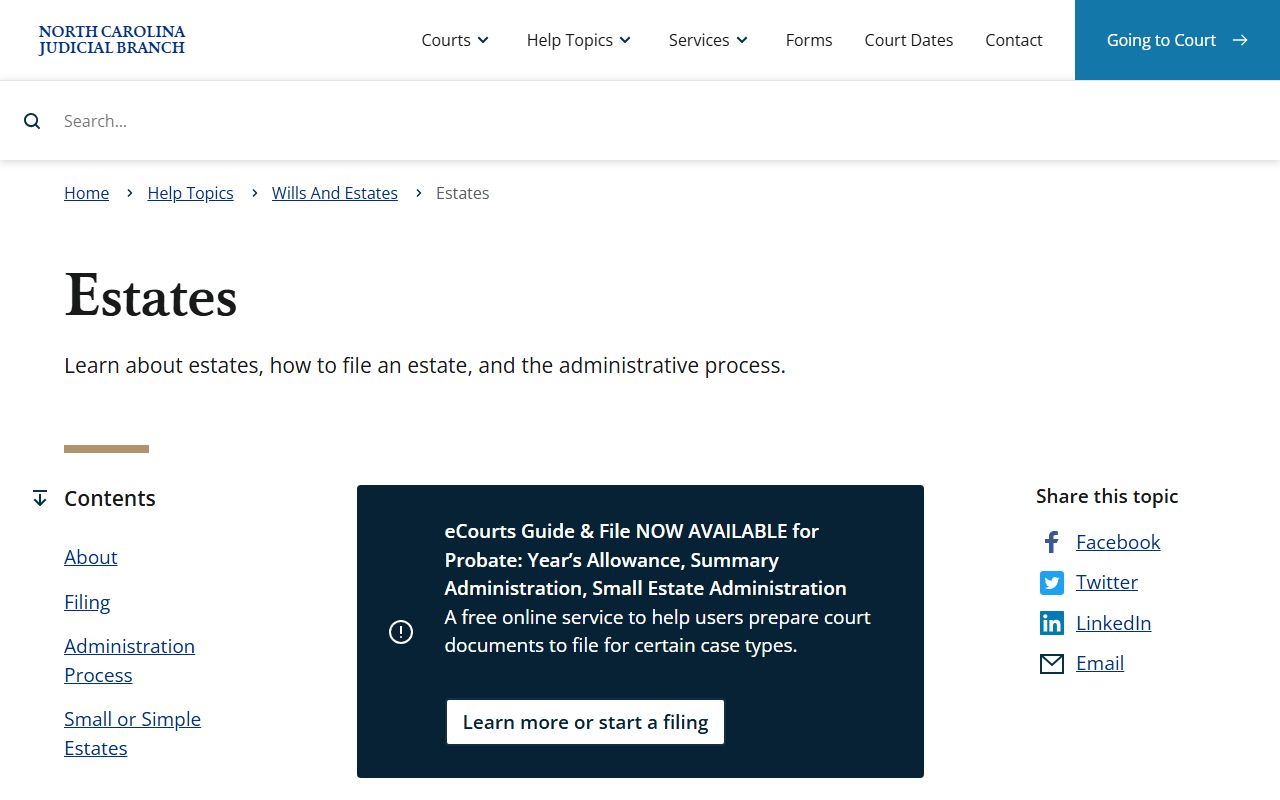
The statewide estates page supports Madison County probate access because the local clerk follows the North Carolina estate administration framework.
Probate Terms Defined
Estate files use terms that are common in North Carolina clerk proceedings. These definitions help distinguish the person who died, the person handling the estate, and the clerk-issued papers that authorize action.
- Testator
- The person who made a will before death.
- Executor
- The person named in a will to carry out estate duties after the clerk qualifies that person.
- Intestate
- A death without a valid will, so administration follows North Carolina succession rules.
- Letters
- Clerk-issued authority, such as letters testamentary or letters of administration, used with banks and other holders of estate assets.
- Personal representative
- The executor or administrator responsible for collecting assets, giving creditor notice, paying valid debts, and distributing property.
Search Madison County Probate Records
Madison County probate records may be searched through public court channels when the estate or special proceeding is available, but the paper file remains tied to the county clerk. Start with online case information, then use the public self-service terminal or clerk counter for older files, paper inspection, and copies. The Clerk of Superior Court can confirm whether a will has been filed after death and whether the estate file is open for public inspection.
- Use North Carolina eCourts Portal Smart Search for estate or special proceeding case information where public.
- Filter to Madison County when searching by a decedent name, personal representative name, or case number.
- If no online result appears, call the Clerk of Superior Court at (828) 649-2200 and ask about public terminals, older files, and paper estate records.
- Visit the clerk's office in the county where the estate is administered to inspect a public estate file.
- Request copies from clerk staff and confirm any copy or certification cost before paying.
The Madison County Register of Deeds online search is useful for land and recorded instruments, but probate files are clerk records. Its online-search disclaimer still matters when an estate issue involves recorded property records or redaction of personal identifying numbers.
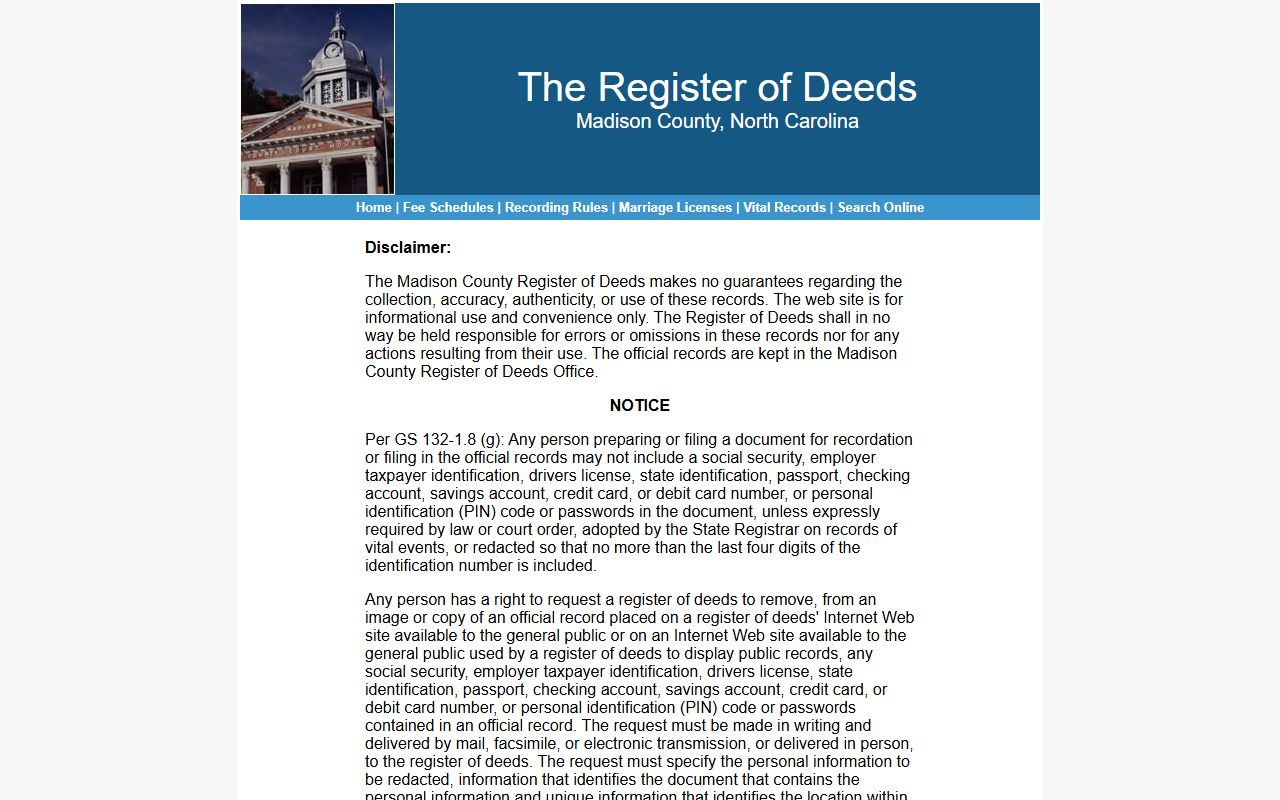
The Register disclaimer helps distinguish official recorded land records from Madison County probate records held by the Clerk of Superior Court.
Madison County Probate Court Office
Madison County does not have a separate probate court building or a separate probate judge page in the official sources reviewed. The Clerk of Superior Court acts as probate judge for most estate cases. The official Judicial Branch courthouse page lists the Clerk's Office and temporary courthouse at Madison County Extension Office, and it states that the 2 North Main Street courthouse is closed until further notice.
Madison County Clerk of Superior Court
Probate role: Clerk acting as probate judge for estates
258 Carolina Lane
Marshall, NC 28753
(828) 649-2200
Detailed hours block lists 8:30 a.m. to 5:00 p.m., Monday through Friday
Mail for the Madison County Courthouse is listed as PO Box 217, Marshall, NC 28753. Because the public counter is operating from the temporary Carolina Lane location, probate visitors should verify the current address before bringing a will, death certificate, inventory, or estate filing fee.
Madison County Probate Fees
The Judicial Branch estates help topic lists a filing fee for applying for letters in an estate. Other Madison-specific estate copy or certification fees were not located in the research file, so those amounts should be confirmed with clerk staff before requesting copies.
| Item | Amount |
|---|---|
| Estate application for letters | $120 |
| Certified estate copy | Confirm with Clerk of Superior Court |
| Plain estate copy | Confirm with Clerk of Superior Court |
| Related recorded land copy from Register | Register fee schedule may apply if a deed or recorded instrument is needed |
What Madison Probate Records Show
A Madison County estate file may show the decedent name, county of domicile, will, application for letters, preliminary inventory, certified death certificate, personal representative, letters, inventory and accounting records, creditor notice, clerk orders, and hearing entries. The file may also show whether the estate is testate, meaning there is a will, or intestate, meaning administration proceeds without one.
| Field or document | What it shows |
|---|---|
| Decedent name | The person whose estate is being administered. |
| County of domicile | The county that determines the proper estate venue for a North Carolina resident. |
| Will | Public after filing following death, unless restricted by law or court order. |
| Application for letters | The filing that starts formal administration. |
| Preliminary inventory | Initial estate asset information. |
| Letters | Clerk authority for the personal representative. |
| Inventory and accounting | Estate assets, debts, and administration activity. |
| Orders or hearings | Clerk or Superior Court judge activity, including will caveat issues when applicable. |
Restricted Madison Probate Records
Filed estate records are public unless a statute or court order restricts specific information. Living wills deposited for safekeeping should not be treated the same as a public estate file after death, so the clerk should verify access. Minor information, sealed documents, protected personal identifiers, and related matters may be redacted or restricted.
When an estate involves real property, related deeds or recorded instruments may appear through the Register of Deeds. The Register's disclaimer cites G.S. 132-1.8(g), which allows written no-fee requests to redact certain personal identifying numbers from online official-record images. That redaction route does not make the Register the probate custodian; it only controls the online image or copy in the Register system.
Note: Probate records and land records can overlap in an estate, but the Madison County Clerk of Superior Court remains the probate file custodian.